

The Only Moat Is Deployment
$6.4B went into Physical AI last quarter - for good reason. But the software investing playbook doesn't apply here.

The shiny new robot that someone spent years creating worked perfectly in the lab, but it toppled over the second it hit the job site. Not a failure of the model – a collision with reality. Concrete expands, Wi-Fi drops behind rebar, and construction noise throws off calibration.
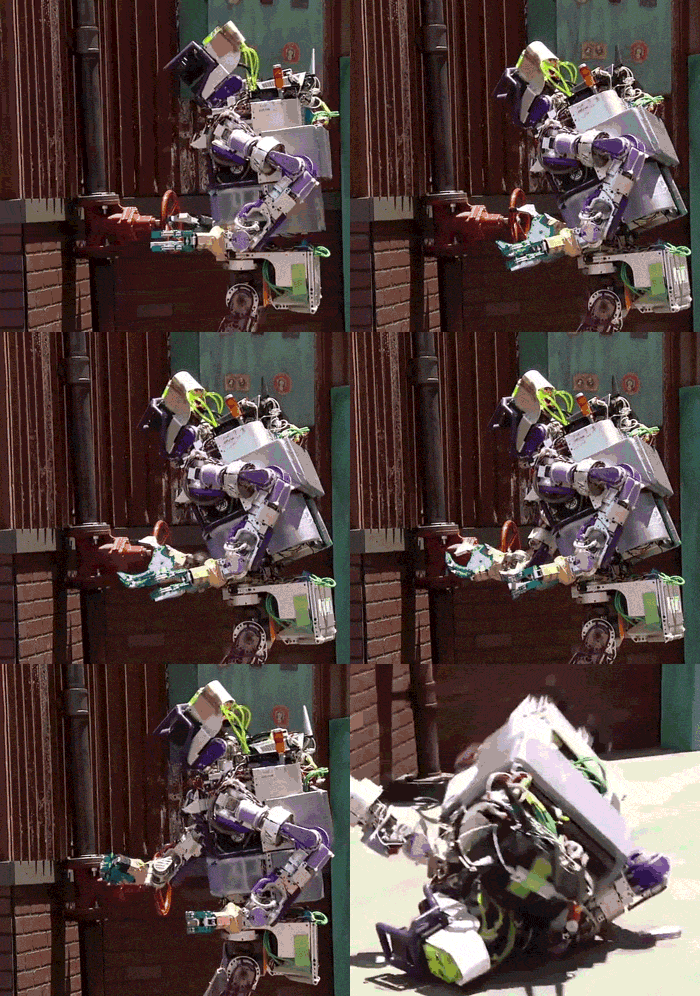
Everyone loves this story. It’s the running joke of Physical AI in 2026.
While robotics is not easy, the reality is that the field is much further along than people think. Robots are on construction sites, in factories, and in warehouses right now, doing paid work for real customers. FieldAI just crossed $100 million in revenue and customer contracts - real money from robots working mines and job sites, and raised $405 million to keep deploying. While that “falling robot” image persists in the public imagination, the industry has already moved past it.
That gap between the meme and reality is exactly where the opportunity lies. And since everyone and their mothers are talking about Physical AI right now, here’s what we keep coming back to: the standard software playbook does not quite fit. These are the things that matter.
Bring a Capital Story
$6.4 billion went into Physical AI startups in Q1 2026 alone, across 27 deals. And the capital is flowing for good reason: the technology has genuinely improved. VLAs work, robot arms are cheaper, LiDARs cost a tenth of what they did five years ago.
Hardware timelines differ fundamentally from software cycles. Deploying a robot requires weeks of on-site integration rather than the rapid provisioning of a virtual machine. This is simply the nature of the work.
While a great product story often suffices in software, Physical AI demands a clear capital story: what you’ll raise, when, and what each deployment milestone unlocks. The best founder we’ve heard of walked us through exactly that. That confidence told us more than the demo did.
The Moat Is Deployment
Stop obsessing over the model. Everyone has a frontier model; the real edge is simply getting the thing to work in the field.
Getting a robot live and learning from it beats any simulation data you can generate. The teams that are great at commercializing and deploying are learning faster than everyone else, every single day. Being on the factory floor, understanding the workflows firsthand, earning the trust of plant managers site by site: that’s a compounding advantage, and it’s available right now to anyone willing to show up.
Whether it’s the Synphony team automating strawberry harvesting, or Generalist and Eka Robotics getting models into real-world hands, the winners are the teams that prioritize shipping over research excellence. Every deployment generates data that the next competitor can’t buy.
Everyone debates the nuances of data collection – egocentric, teleops, and tactile – and the choice between custom- and off-the-shelf hardware. Because so much of data collection is labor-intensive, the specific tech choice matters less than the approach. We’re looking for a clear data strategy that proves your advantage will compound over time.
Work with the Gatekeepers
Siemens, Honeywell, and ABB are established incumbents managing enterprise robotic fleets. As full-stack startups and ‘robot-as-a-service’ models gain ground, the role of these traditional gatekeepers is in flux. The likely winning strategy will include these incumbents in some shape or form - it’s never too early to start building those relationships.
Pilots and the War Chest
Here’s a place where the software rules half-apply. War chests matter in this category. Hardware cycles are long, and if a robotics winter comes, capital is what carries you through it. Pilots are great - but we’re so early in the cycle that it’s hard to read into the revenue unless there are customers ready to order 1000s of robots.
But indigestion is real, too. Too much money too early leads to overstaffing and over-equipping before you understand the environment you’re deploying into. The tell is headcount growing ahead of deployed revenue; it shows up before the burn does. The healthiest pattern we see: raise for resilience, but let milestones set the pace. Unit economics do ultimately matter, as we can’t transform the world without it - and a large war chest can give you time to subsidize things, but that can’t be the crutch.
While startups can raise too much and cause indigestion, physical AI milestones are more than just hitting 3x ARR with nice SaaS metrics.
What Actually Scales
This category has no shortage of brilliant engineers. What it’s short on: founders who can walk into a facility, win over a plant manager who has sat through ten robotics demos, and structure a deal that survives procurement.
Add the grit to keep operating through real-world setbacks and the pull to recruit engineers who’ll happily show up to a job site at 6 am, and you have the rarest profile in the category. Worth leaning into hard when you find it. In diligence, that means spending as much time with the commercial founder as the technical one, and asking who closed the last three deals.
Where the Winners Are Emerging
Winners are emerging where labor is expensive, and the customer has real buying power. Industrial use cases from warehouse to manufacturing to chemicals and logistics - structured environments drive rapid data accumulation and unit volume at scale.
The less obvious opportunity lies in the middle of the stack: simulation infrastructure, sensing, and operational tooling. Cloud ran the same play: the headlines went to the apps, but Datadog and Snowflake won in the middle. Physical AI will produce the same kind of quiet platform winners.
And on the headline products themselves: vertically integrated robotic companies that customers can train on new tasks is the decade-long bet; narrow vertical applications are the three-year story. Both can be true, but they have different risk profiles and may not be the same company. Whether a given capability ends up as a feature or a platform depends on how fast vertical integration moves — and it’s genuinely too early to call.
The Long Game
The hardware is finally ready, and the models are capable enough to matter. Real-world deployments are generating actual revenue today, proving that the old “falling robot” caricature is well out of date.
The industry’s primary metric will shift from ‘total operational hours’ to ‘number of robots per customer’.
Scaling into these environments — where everything is tested, and nothing is guaranteed — is the real challenge. It takes years, not quarters, but that’s exactly why the companies deploying now are building something truly durable. The teams showing up to do the hard work today are earning their place in the room. The failing robot meme belongs in a different era.
Teams are building the advantage that will be obvious in the next five years and impossible to replicate.